
Stop Wasting Paint: The Complete 1K Primer Troubleshooting Guide
You’ve applied your 1K primer, waited for it to dry, and moved on to the next step — only to find peeling, dullness, or sanding issues ruining your finish.
Frustrating, but extremely common.
As an automotive coating factory, we’ve analyzed thousands of real-world cases from body shops and distributors. Most 1K primer problems are not random — they come from predictable issues related to application, drying, and material compatibility.
In practice, many professionals choose to work with a reliable car paint supplier to ensure stable performance across different conditions. For larger-scale operations, partnering with an experienced OEM automotive paint supplier helps maintain consistent quality and reduce long-term risks.
In this guide, you’ll learn:
·The 7 most common 1K primer problems
·Why they happen (based on real workshop data)
·How to fix and prevent them permanently
What Is 1K Primer? (Quick Understanding)
1K primer is a single-component coating that dries through solvent evaporation.
Key characteristics:
·Fast drying
·Easy to use
·No hardener required
But also:
Highly sensitive to:
·Solvent compatibility
·Application thickness
·Recoat timing
1K vs 2K Primer: Which Should You Use?
| Type | Advantages | Disadvantages | Best For |
| 1K Primer | Fast, easy, cost-effective | Lower durability, sensitive | Quick repairs, spot jobs |
| 2K Primer | Strong adhesion, chemical resistance | Slower, more complex | Professional refinishing |
Insight:
In professional environments, 2K primer is preferred for durability, but 1K remains widely used due to speed and simplicity.
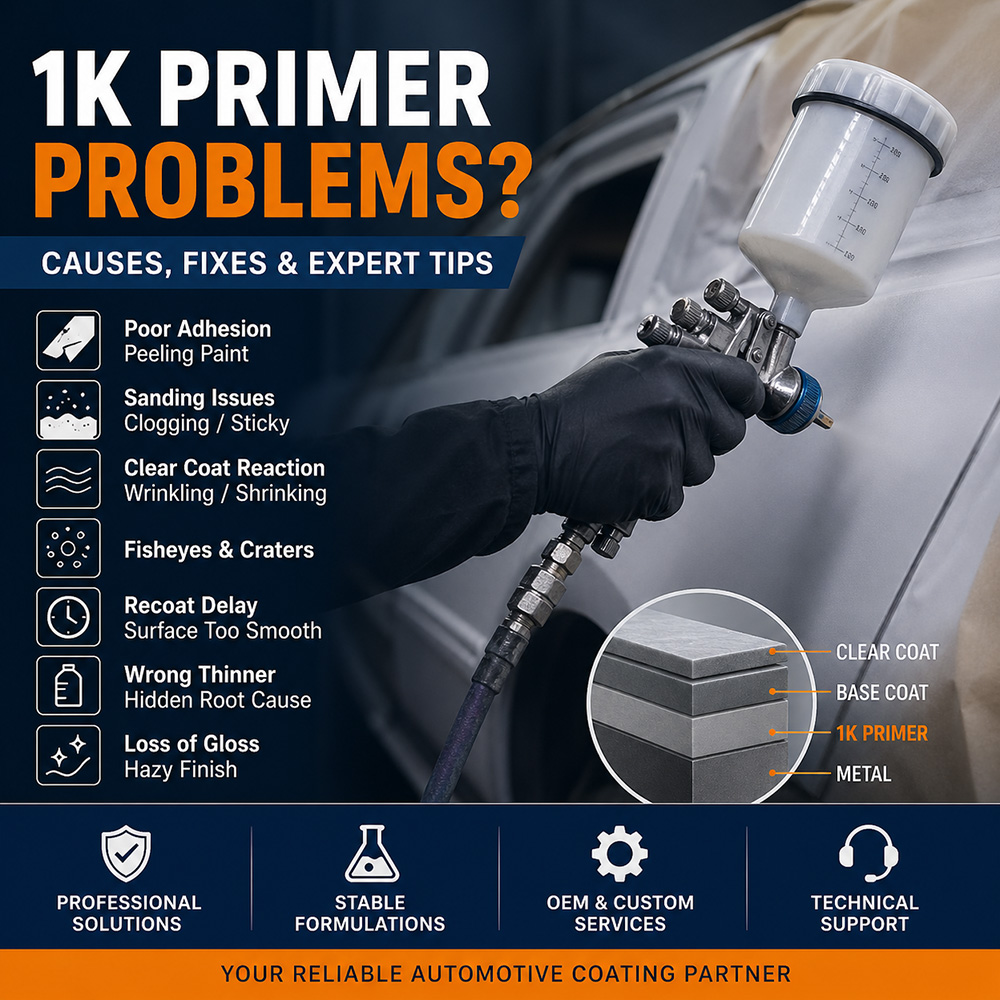
1. Poor Adhesion (Peeling Paint)
What you see:
Paint peels off like a film.
Why it happens:
In over 70% of cases, this is caused by:
·Missing recoat window (>4 hours)
·Surface contamination (dust, silicone)
·Weak thinner quality
How to fix:
·Sand with 600–800 grit before recoating
·Clean with silicone remover
·Apply topcoat within recommended time
2.Sanding Issues (Clogging / Sticky Surface)
What you see:
Sandpaper clogs immediately.
Why it happens:
In most workshops, this is due to:
·Excessive film thickness
·Incorrect thinner (fast or low-quality)
·High humidity (>70%)
How to fix:
·Apply thin, even coats (2–3 passes)
·Use recommended thinner
·Allow full drying (or use controlled heat)
3.Clear Coat Reaction (Wrinkling / Shrinking)
What you see:
Wrinkles or surface distortion after clear coat.
Why it happens:
·Primer not fully cured
·Strong solvents re-activate the layer
·First coat applied too wet
How to fix:
·Extend drying time
·Apply a light “mist coat” first
·Then follow with a full wet coat
4. Loss of Gloss (Hazy Finish)
What you see:
Dull or milky clear coat.
Why it happens:
·Solvent absorption into primer
·Incomplete drying
·Overly thick primer layers
How to fix:
·Ensure full drying before topcoat
·Control film thickness
·Re-sand and reapply if necessary
5. Fisheyes & Craters
What you see:
Small circular holes in the surface.
Why it happens:
·Silicone contamination
·Oil or dirt residue
·Compressor contamination
How to fix:
·Clean thoroughly before spraying
·Install air filtration system
·Avoid masking the issue with additives
6. Recoat Delay (Surface Too Smooth)
What you see:
Peeling after delayed painting.
Why it happens:
After 24–48 hours:
·Primer oxidizes
·Surface loses bonding ability
How to fix:
·Re-sand before recoating
·Or apply a fresh primer layer
7. Wrong Thinner (Hidden Root Cause)
What you see:
Multiple issues at once.
Why it happens:
In many real cases:
·Hardware-store solvents
·Unknown evaporation rates
·Contaminants inside cheap thinners
How to fix:
·Use manufacturer-recommended thinner only
·Ensure compatibility within the system
Pro Insight: Why Most 1K Primer Failures Happen
Across real-world applications, the majority of failures come down to three factors:
1.Application thickness control
2.Drying and timing discipline
3.Material system compatibility
👉 Not just technique — material consistency matters just as much.
Quick FAQ
Can I apply 1K primer over old paint?
Yes, but sand the surface (400–600 grit) to ensure adhesion.
How long should 1K primer dry before sanding?
At 20°C:
·Dust-free: 30–60 minutes
·Sanding: 2–4 hours
Can I use 1K primer on plastic?
Only if it’s designed for plastic. Otherwise, use an adhesion promoter.
Why does my primer look like orange peel?
Usually caused by:
·Thick application
·Incorrect spray distance
·Improper thinner
Pro Checklist: Perfect 1K Primer Application
·Clean surface thoroughly
·Sand substrate properly
·Use compatible thinner system
·Apply 2–3 thin coats
·Control drying environment
·Recoat within proper window
·Sand if delayed
Looking for a More Stable 1K Primer Solution?
If you’re experiencing repeated issues like:
·Poor adhesion
·Sanding problems
·Inconsistent drying
It may not only be technique — material stability plays a critical role.
We provide:
·Stable 1K primer systems
·Matched thinner solutions
·Technical support for distributors & body shops
For consistent results, many body shops and distributors prefer working with a reliable car paint supplier that provides stable formulations and compatible coating systems.
Choosing an experienced OEM automotive paint supplier is essential for ensuring long-term consistency, batch stability, and full system compatibility across primers, thinners, and topcoats.
Today, China-based primer manufacturers have become key partners for global distributors seeking cost-effective, scalable, and OEM-ready coating solutions.
Need Help Diagnosing Your 1K Primer Problem?
Still not sure what’s causing your primer failure?
Our technical team can help you identify the root cause based on your application process, environment, and materials — and recommend a more stable and compatible solution.
👉 Contact us to get technical support or request product recommendations.
