Choosing between 1K and 2K primer is one of the most common decisions in automotive refinishing. While both are widely used, they serve very different purposes in terms of durability, application process, and long-term performance.
As an automotive coating factory, we’ve worked with body shops, distributors, and OEM clients across different markets. In practice, many coating failures are not caused by application mistakes, but by choosing the wrong primer system from the beginning.
Understanding the difference between 1K and 2K primer is key to achieving consistent and reliable results.
What Is 1K Primer?
1K primer is a single-component coating that dries through solvent evaporation. It is widely used because of its simplicity and fast drying speed.
Typical characteristics of 1K primer include:
Ready to use, no mixing required
Fast drying time
Easy sanding
Suitable for quick repairs and small-area jobs
Because of its convenience, 1K primer is often preferred in situations where speed and efficiency are the priority.
What Is 2K Primer?
2K primer is a two-component system that requires mixing with a hardener. It cures through a chemical reaction rather than simple evaporation.
Key features of 2K primer include:
High durability and strong adhesion
Excellent resistance to chemicals and weather
Better long-term performance
Suitable for full-body refinishing and high-end applications
Compared to 1K systems, 2K primer provides a more stable and robust coating foundation.
Key Differences Between 1K and 2K Primer
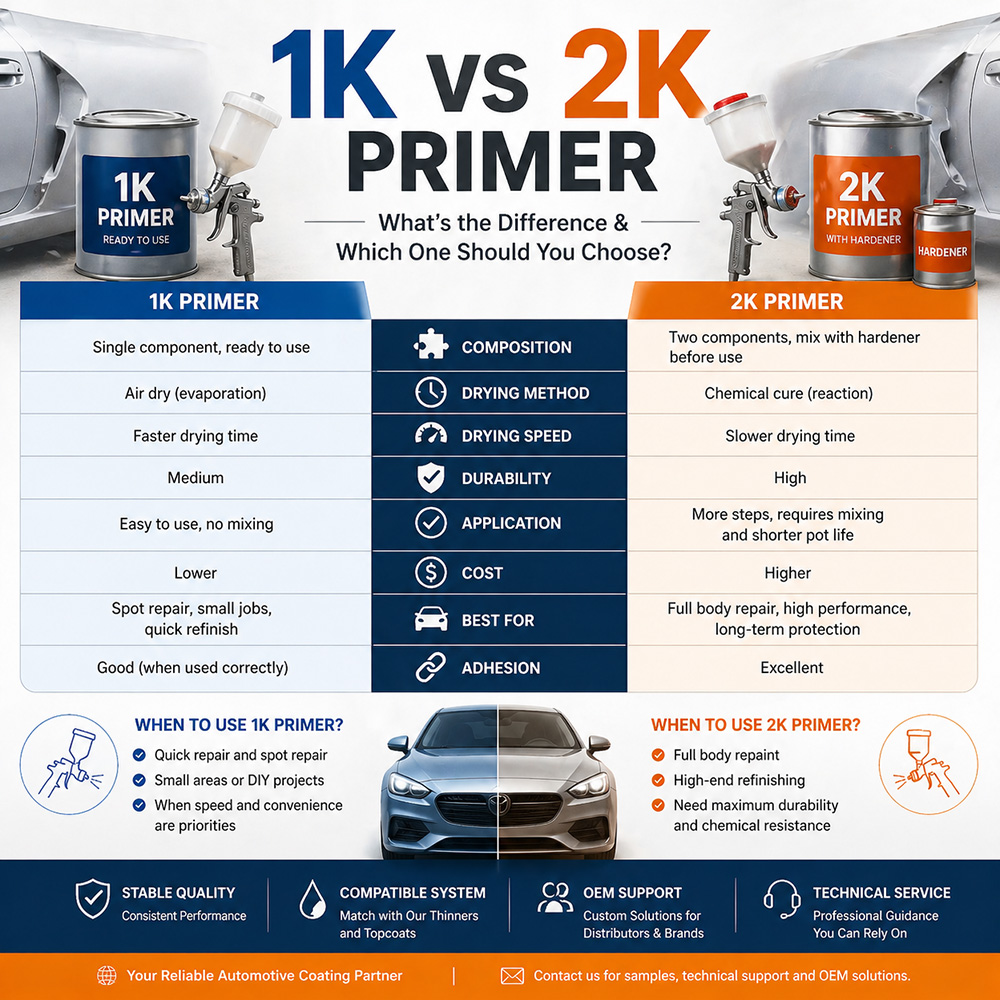
The core difference lies in how the coating cures and performs over time.
Drying method:
1K primer air-dries through evaporation, while 2K primer cures chemically with a hardener.
Durability:
1K offers moderate durability, while 2K provides significantly higher resistance and longevity.
Application:
1K is easier to apply with fewer steps, while 2K requires precise mixing and timing.
Cost:
1K is more cost-effective, while 2K involves higher material and labor cost.
In professional automotive paint systems, primer selection directly affects adhesion, compatibility with basecoat and clearcoat, and overall coating stability.
When Should You Use 1K Primer?
1K primer is ideal for:
Spot repairs
Small-area refinishing
Fast turnaround jobs
Situations where ease of use is critical
For many workshops, 1K systems provide a practical solution when speed and cost control are the main concerns.
When Should You Use 2K Primer?
2K primer is recommended for:
Full vehicle repainting
High-end refinishing projects
Applications requiring maximum durability
Long-term performance and protection
In these scenarios, the additional strength of 2K primer ensures better results over time.
Can 1K and 2K Primer Be Used Together?
Yes, but compatibility is critical.
In many cases, 1K and 2K products can be used within the same automotive coating system, but only when:
The surface is properly prepared
Recoat timing is controlled
Materials are compatible
This is why many professionals prefer working with a reliable car paint supplier that can provide a complete and tested coating system rather than isolated products.
Pro Insight: Why Primer Selection Matters More Than You Think
Based on real-world applications, most coating failures come down to three factors:
Incorrect primer selection
Poor material compatibility
Unstable thinner or system mismatch
Choosing the right primer is not just about convenience — it is about ensuring the entire coating system performs consistently.
For distributors and large-scale users, working with an experienced OEM automotive paint supplier helps ensure batch stability, product consistency, and long-term reliability.
Today, China-based primer manufacturers have become key partners for global buyers seeking cost-effective and scalable automotive coating solutions.
Need Help Choosing the Right Primer System?
Not sure whether 1K or 2K primer is the best fit for your application or market?
As an automotive coating factory, we support distributors, body shops, and OEM clients with stable formulations, compatible thinner systems, and technical guidance.
Contact us to get professional recommendations or discuss OEM automotive paint solutions.
